
What One Ingredient Can Cost You, and Why We Take It Out Anyway
A founder brings us a product she loves. It performs, her customers would recognise the texture, and she wants something close to it under her own name. This is one of the most common ways a project starts, and it is a good way to start one. A benchmark is real evidence that a formula works.
Then we read the ingredient list, and somewhere in it sits mineral oil.
What mineral oil actually is
Cosmetic-grade mineral oil is one of the most studied materials in the industry. It is highly refined, chemically inert, and does not react with skin. Dermatologists use it on compromised skin barriers precisely because it does so little.
The alarming claim people repeat online comes from a classification that applies to untreated industrial oils, not to the USP grade that goes into skincare. On a safety basis, this ingredient sits near the bottom of any honest risk list.
We are not going to tell you mineral oil is dangerous. It isn't. We are going to tell you what it costs.
Where the problem actually is
The problem is not toxicology. It is the shelf.
Most major clean retail standards exclude petroleum-derived ingredients outright. Not after a case-by-case review, not with an exemption for highly refined grades. The line is drawn at the origin of the material and it is held. A buyer running your ingredient list against an exclusion list does not weigh the evidence. They search for a name.
So the practical consequence of one line on your INCI is this: certain retailers are closed to you, and you will not find that out until you are already pitching them.
There is a second cost, quieter and slower. A brand built on a plant-based story has to keep explaining why a petroleum derivative sits in the formula. Every explanation is a small withdrawal from the account you are trying to build.
A benchmark tells you what works. It does not tell you what the ingredient list will cost you two years from now.
Why we default to clean on benchmark briefs
Market leaders got where they are by making products people love. That does not mean every choice in their formula fits every brand that admires it. Those products were built under different constraints, for different channels, sometimes a decade ago, and often for a shelf that has no exclusion list at all.
When we build to a benchmark, we take the performance as the target and the ingredient list as a draft. Match what the product does. Rebuild whatever will not survive the standard the brand is aiming for.
The part founders do not see
Here is what that actually looks like.
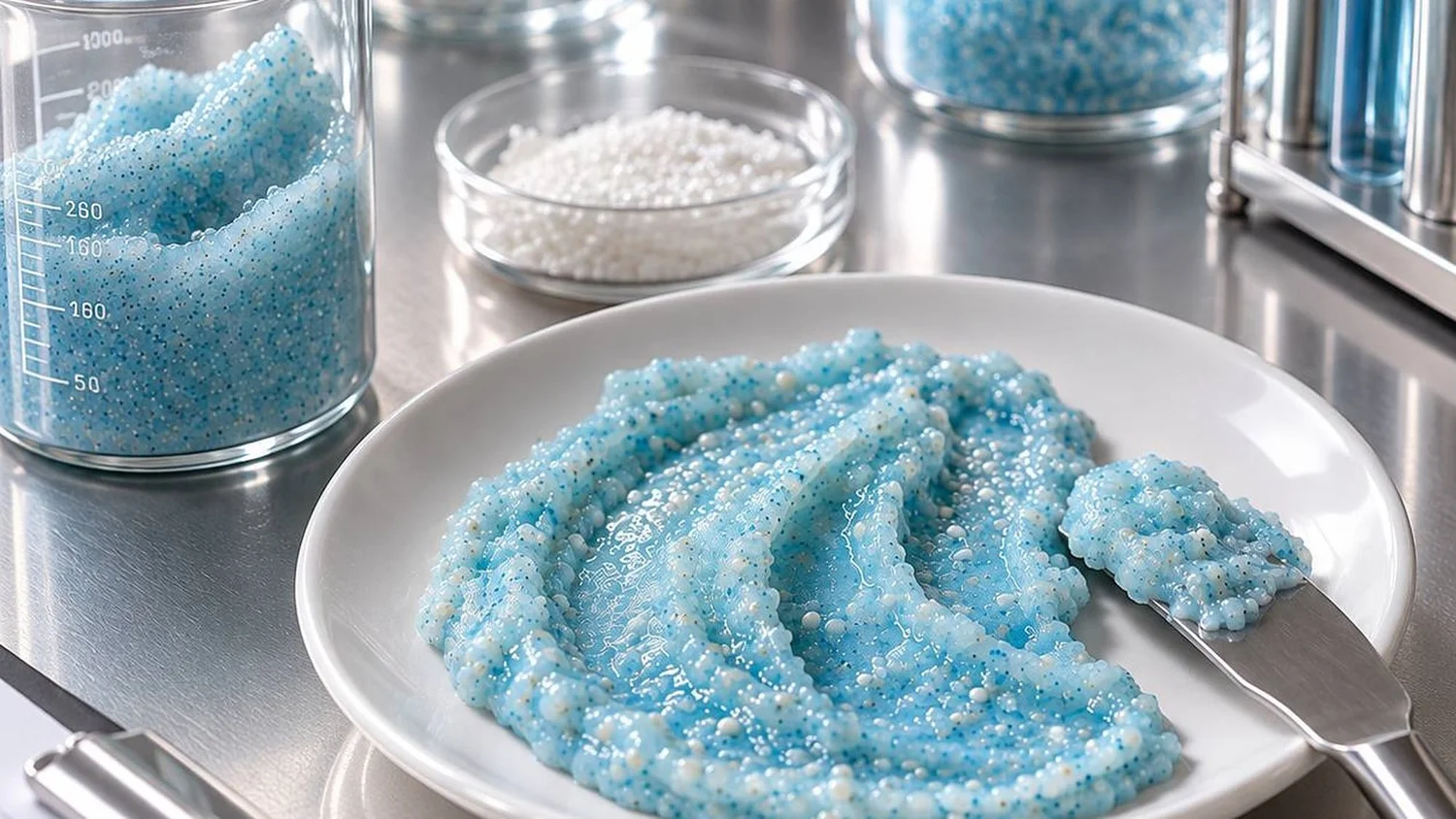
Take a waterless scrub. Its granules are water-soluble, which means a single drop of water in the formula and they begin to disappear. The whole product has to stay anhydrous.
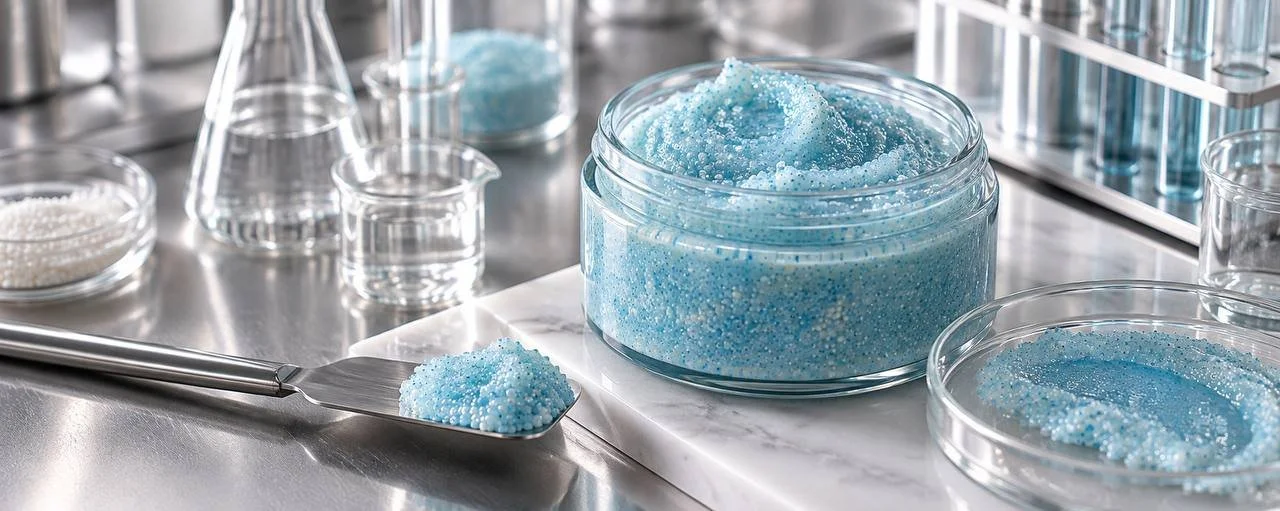
In that system, mineral oil is not one ingredient doing one job. It is doing three at once: giving slip so the granules glide instead of dragging, holding those granules in suspension so they do not sink to the bottom of the jar, and leaving no greasy film when the product rinses.
Replace it with the first plant oil that comes to mind and you get a heavier texture, or separation, or a residue the customer notices on day one. The replacement has to be anhydrous, light, non-occlusive, and compatible with everything already in the base.
The ingredient swap takes a minute. Keeping the product exactly as good takes weeks.
That is the honest cost of a clean reformulation, and it is almost never on the first quote a founder receives. New raw material. Reworked ratios. A fresh stability run, because changing the emollient changes how the whole system behaves over time.
What to do with this if you are building a brand
Three questions worth asking before you commit to a benchmark.
- Which retailers do you want to be on in two years, and what is on their exclusion list today? Pull the actual list. Most are public.
- Is every ingredient in your formula one you can explain in a sentence to a customer who asks? Not defend. Explain.
- If you had to reformulate this product in eighteen months, which ingredient would be hardest to replace? That is the one to deal with now, while there is no deadline.
Our position
We are not in the business of telling founders their favourite product is bad. It usually isn't.
We are in the business of making sure the formula with your name on it can go wherever you decide to take it. That means the default is clean, deviations happen only by your explicit decision, and you always know what each choice opens and closes.
Not sure what is inside your own formula?
We build clean beauty formulas for brands that have to answer that question in front of a retailer. Send us your current INCI and we will tell you plainly what would change.